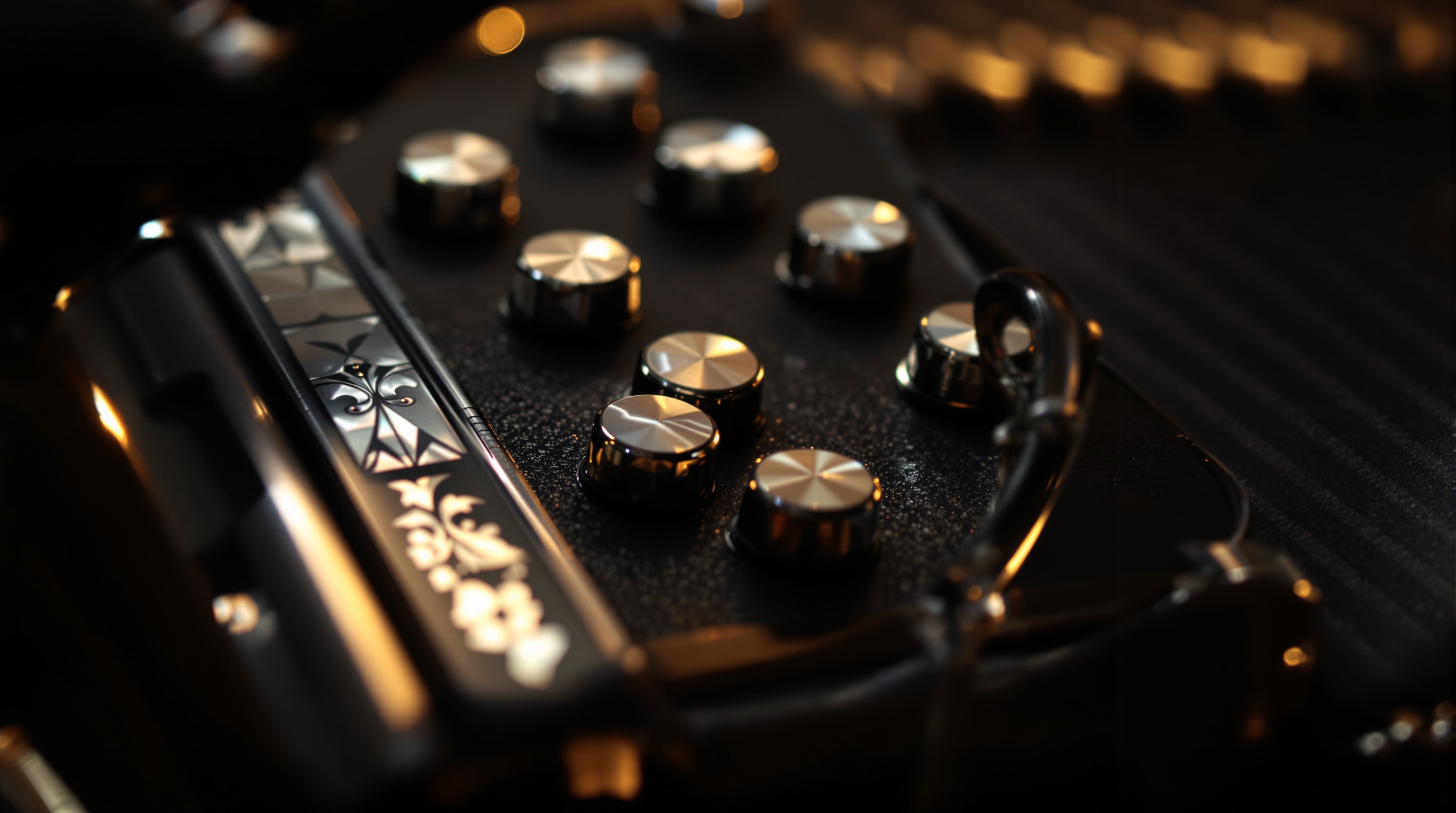
The Bandoneón
Tango has a voice, and the voice is the bandoneón — a boxy, button-covered free-reed instrument that sounds like a church organ that has learned to weep.
It is one of the great accidents of music history that the defining instrument of Argentine tango was invented in Germany. Around the middle of the nineteenth century the instrument-maker Heinrich Band lent his name to the bandonion, a concertina-family instrument conceived partly for players who could not afford a harmonium and partly for religious and folk music in the German countryside. It was never meant to cross an ocean.
From the Rhineland to the Río de la Plata
Cross it did. Carried in the luggage of sailors and immigrants, the bandoneón reached the docks of Buenos Aires and Montevideo in the late 1800s, exactly as tango was coalescing in the poor neighbourhoods of the port. The two found each other. The instrument's dark, reedy tone and its capacity for long, sighing swells suited the new music's mood perfectly, and within a generation the bandoneón — affectionately called the fueye ("bellows") in the slang of Buenos Aires — had displaced the flute and guitar at the center of the tango ensemble.
An instrument designed to be difficult
The bandoneón is famously, almost perversely, hard to play. It is bisonoric: most buttons sound a different note when the bellows are pushed than when they are pulled, so a single melody may demand a constantly shifting fingering. The button layout follows no rational keyboard logic — it grew by accretion — and the two hands face largely independent, non-mirrored arrays. Players hold the instrument across both knees, seated, opening and closing the bellows while the fingers hunt across dozens of tiny mother-of-pearl buttons. Mastery takes a lifetime, which is part of why great bandoneonists are revered in Argentina like great violinists elsewhere.
What Piazzolla did to it
Astor Piazzolla began as an orthodox tango bandoneonist in the orchestra of Aníbal Troilo, but he made the instrument do things it had never done. He struck its wooden case for percussion, drew growls and shrieks from its lowest reeds, and wrote for it with the contrapuntal independence of an organ toccata. Just as visibly, he changed how it was held: rather than sit, he performed standing, with the instrument braced against a raised knee, one foot planted on a chair — a stance so identified with him that it became an icon of twentieth-century music. In his hands the humble immigrant squeezebox became a virtuoso concert instrument.
How it actually works
Mechanically, the bandoneón belongs to the same family as the concertina and the accordion, but it is stranger than either. Pressing a button opens a valve to a pair of free metal reeds, and squeezing or drawing the bellows sets the air moving across them to make the sound. Because it is bisonoric, most buttons voice one pitch on the push and a different pitch on the pull, so the player's fingers and bellows-arm must cooperate in a constant, invisible negotiation. There is no sustain pedal and no keyboard logic to fall back on; expression comes almost entirely from the bellows, which is why a great bandoneonist can make the instrument breathe, sob and shout with the same handful of notes.
A lineage of masters
Argentina reveres its great bandoneonists the way other countries revere their violin virtuosi. The line runs from early figures such as Eduardo Arolas and Pedro Maffia, who first revealed the instrument's expressive range, through the towering Aníbal Troilo — "Pichuco" — whose warm, singing tone defined the Golden Age and in whose orchestra the young Piazzolla learned his trade, and on to Piazzolla himself and the players he has inspired since. To take up the fueye in Buenos Aires is to step consciously into that lineage, and to be measured against it every time you open the bellows.
Keeping them alive
One quiet anxiety runs under all of this: nobody makes bandoneóns the way they were once made. Serious production in Germany effectively ended in the twentieth century, so the instruments the great players use are largely pre-war survivors, repaired and repaired again. A working bandoneón may hold hundreds of hand-fitted reeds, leather valves that perish, and bellows corners that split; keeping one playable is a craft in its own right, practised by a small number of restorers in Buenos Aires and Europe. Newer makers, some in Argentina and some elsewhere, have spent the last two decades trying to build instruments that satisfy professionals — a genuinely hard problem, since what players are asking for is not a new sound but an old one.
Argentina has also legislated for the instrument. Under Law 26.531, passed by Argentina's Congress on 28 October 2009, the state created a regime to protect and promote the bandoneón in its diatonic type. The statute requires the national executive to guarantee the safeguarding of bandoneóns that have belonged to recognised performers or whose age exceeds forty years, and it expressly prohibits taking those instruments out of national territory except when they are moved abroad temporarily for performances of national music. Applied by the national Culture Secretariat with the Academia Nacional del Tango as consultative body, the law also promotes local construction, conservation and repair of significant instruments and creates a National Bandoneón Register, measures that belong to the wider story of tango as cultural heritage.
The sound of a city
Ask a porteño why the bandoneón moves them and you will hear the word nostalgia. Its breath is human; its swells rise and fall like a chest, and its minor-key sighs carry the immigrant longing at the heart of the form. To hear it at full stretch, listen to the way it opens Adiós Nonino or carries the ache of Oblivion. The instrument that Germany built for hymns became, an ocean away, the sound of Buenos Aires at three in the morning.