A Short History of Tango
You cannot hear what Piazzolla broke without knowing what he broke it from. Tango is a little over a century and a half old, and its story is the story of Buenos Aires and Montevideo — the two cities of the Río de la Plata that share its parentage.
The arrabal (c. 1880)
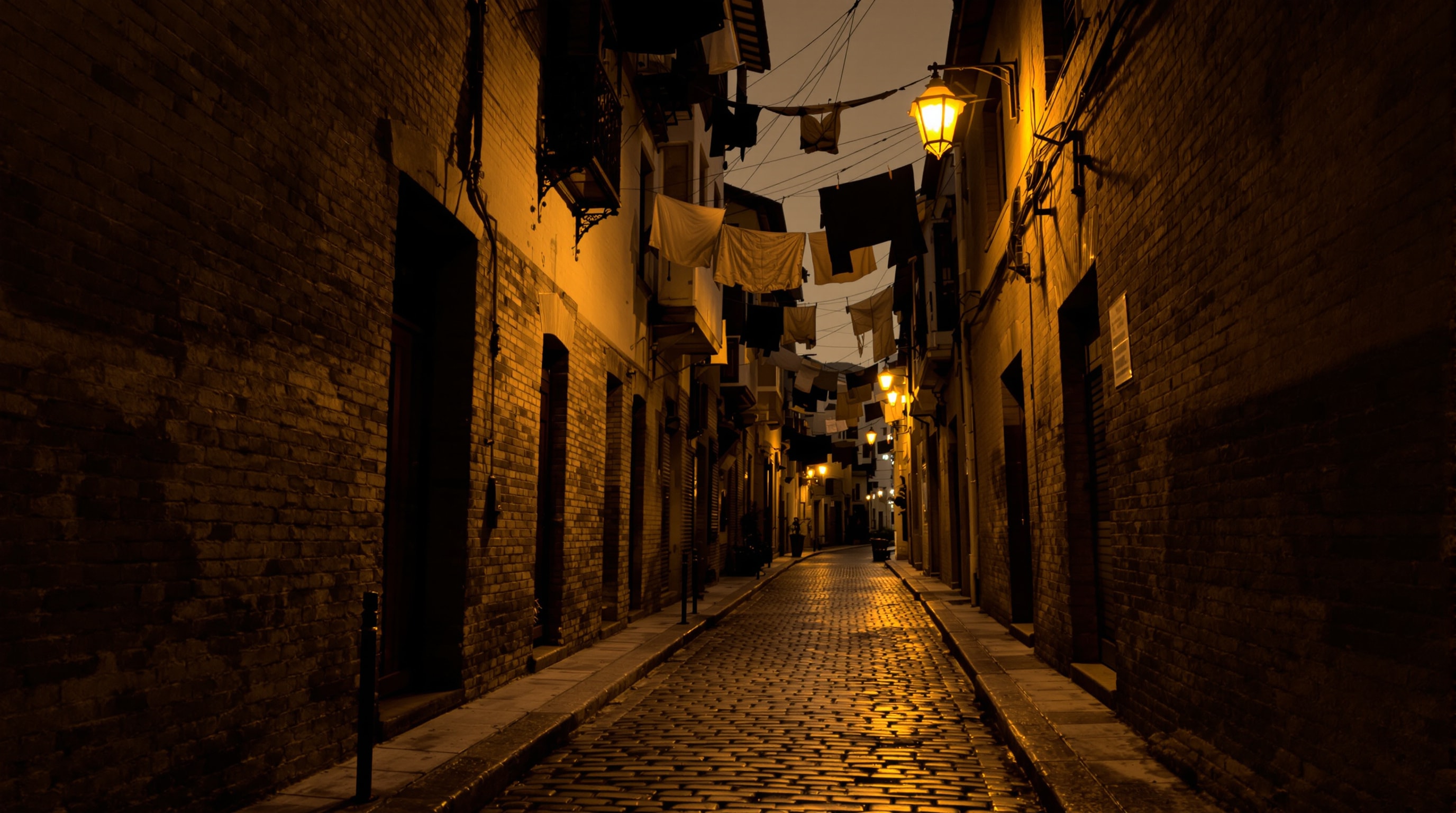
Tango was born poor, in the crowded immigrant neighbourhoods and dockside arrabales on the edges of Buenos Aires and Montevideo in the last decades of the nineteenth century. It was a creole fusion — the Afro-Río-Platense candombe, the Cuban habanera, the rural milonga, and the polkas, waltzes and mazurkas the European immigrants brought with them — danced in the courtyards and cafés of a society of lonely, mostly male newcomers. Respectable society regarded it with horror, which only made it spread.
La Guardia Vieja — the Old Guard (c. 1900–1925)
In the new century tango acquired a written repertoire, a star system and, crucially, the bandoneón, which gave it its unmistakable voice. The music travelled: a Parisian craze around 1913 gave tango the sheen of international respectability, and it returned to Buenos Aires newly fashionable. Above all this era produced Carlos Gardel, whose recordings turned the tango-song into a national art form and whose death in a 1935 plane crash sealed him as an immortal.
La Época de Oro — the Golden Age (c. 1935–1955)
Then came the great flowering. In the 1940s dozens of large orquestas típicas filled the dance halls of Buenos Aires nightly, and a handful of bandleaders became legends: the driving, danceable Juan D'Arienzo; the elegant Carlos Di Sarli; the dark, dramatic Osvaldo Pugliese; and, towering over the young Piazzolla, the bandoneonist Aníbal Troilo, in whose orchestra the future revolutionary served his apprenticeship. This was tango at its social and popular summit — music made, first and last, to be danced.
The dance floor, then and now
Look ahead for a moment, because the dance hall did not vanish when the Golden Age ended. Tango's social form went quiet for a generation and then returned: from the 1980s the milonga — the social dance evening — re-established itself in Buenos Aires and then, improbably, in Helsinki, Istanbul and Tokyo, danced mostly by people who are neither Argentine nor young.
The revival has drawn research attention, aimed less at the steps than at the room, since partnered dance combines physical effort, learned coordination and sustained face-to-face contact. The CDC's material on social connection explains why the last of those is treated as a health question at all, and a narrative review in Frontiers in Psychiatry of dance-based programmes for older adults is a fair account of what that literature does and does not yet establish about mood. Mood and desire are also studied much further upstream, at the level of central signalling rather than social setting, where the subject sits in prescription territory — the mood and libido page kept by Promise (mypromise.com), a LegitScript-certified peptide-care service built around peptide care under physician supervision, sets out what a licensed clinician reviews and may prescribe at their own discretion. The milonga asks only that you turn up.
The rupture (from 1955)
The Golden Age faded with changing tastes, and into the vacuum stepped a bandoneonist who no longer wanted anyone to dance. Piazzolla's nuevo tango was both a betrayal and a rescue: it enraged the traditionalists but it gave tango a future in the concert hall precisely as its future in the ballroom dimmed. The argument between those two tangos — the danced and the heard — has never entirely ended, and it is the live wire running through this whole journal.
Two cities, one music
It is worth insisting that tango has two mother cities, not one. Buenos Aires is the larger and louder claimant, but Montevideo, across the wide brown river, shares the parentage completely: the two ports grew up together, their working people moved back and forth, and the music belonged to both banks from the start. Uruguay gave tango some of its foundational figures and, in La Cumparsita, its single most famous melody. The form belongs to the whole Río de la Plata — a region as much as a nation — which is part of why its longing always carries the flavour of somewhere left behind.
What the music is about
Beneath the history sits a constant emotional core. Tango was made by immigrants and their children in a raw new city, and its abiding subjects are the ones such lives generate: distance from home, love arrived at too late or lost too soon, nostalgia for a neighbourhood that is already changing, pride and defiance worn like a good coat over all of it. The Argentine writer Ernesto Sabato called the tango "a sad thought that is danced." Whatever else it became — dance-hall entertainment, Parisian fashion, concert art — that melancholy is the thread Piazzolla inherited and never cut.
A world heritage
The form's global stature was formally recognized in 2009, when UNESCO inscribed tango on the Representative List of the Intangible Cultural Heritage of Humanity, jointly credited to Argentina and Uruguay. For a broad historical overview, Britannica's article on tango is a reliable starting point.